


News


News

Venues
Videos
Live Streams
Images
About Sanya 2026
THE 6TH ASIAN BEACH GAMES SANYA 2026
DOPING CONTROL GUIDE
The 6th Asian Beach Games Sanya 2026 Organising Committee
November 2025
Preface
The 6th Asian Beach Games Sanya 2026 Doping Control Guide (hereinafter referred to as the "Guide") contains useful information for participants of the 6th Asian Beach Games Sanya 2026 (hereinafter referred to as "Sanya 2026") on the Anti-doping Programme and how the programme will be conducted. The Guide is a summary of key aspects of the rules rather than a detailed set of rules. It is a complement rather than a substitution to the OCA Anti-Doping Rules (hereinafter referred to as "the Rules"). The Guide is the final version, which has been reviewed by the OCA, ITA and CHINADA. All information contained herein is subject to change based on the competition schedule, venue operations, and epidemic prevention and control measures.
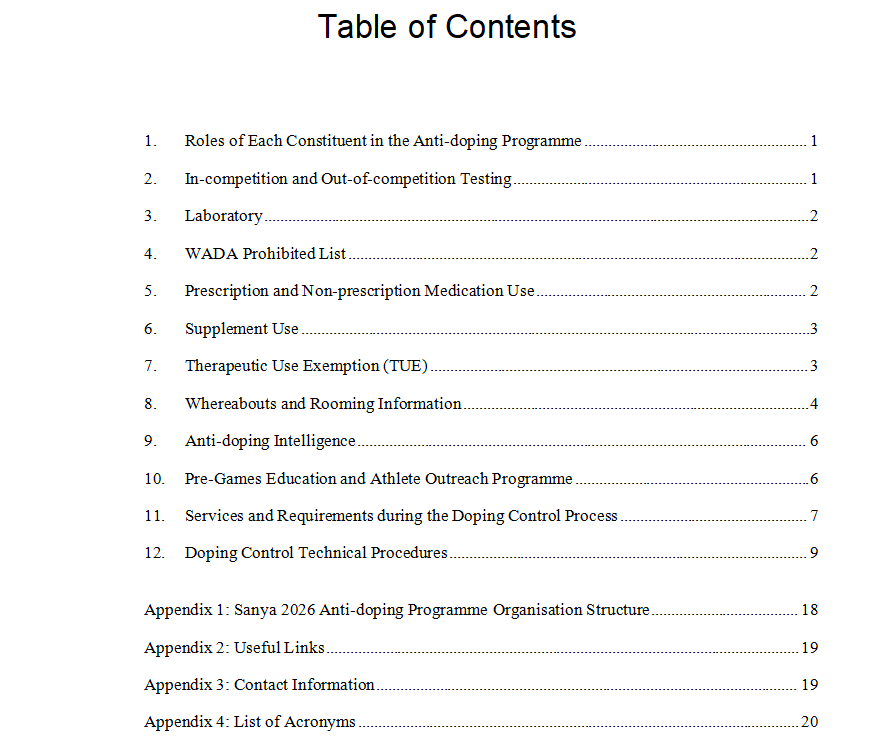
1.Roles of Each Constituent in the Anti-doping Programme
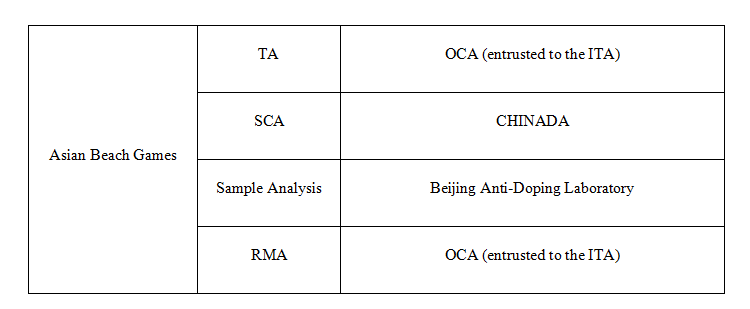
The Olympic Council of Asia (hereinafter referred to as the "OCA") coordinates and guides the Anti-doping Programme during the period of Sanya 2026 (from the official opening of the Athletes Village on 18 April 2026 to the Closing Ceremony on 30 April 2026). The OCA has delegated the management of some anti-doping responsibilities to the International Testing Agency (hereinafter referred to as "ITA"). The OCA will act as the Testing Authority (TA) and the Results Management Authority (RMA) for Sanya 2026. China Anti-Doping Agency (CHINADA) will serve as the Sample Collection Authority (SCA), and Beijing Anti-Doping Laboratory will be responsible for the analysis of the samples. The 6th Asian Beach Games Sanya 2026 Organising Committee (SABGOC) will ensure that the Anti-doping Programme during Sanya 2026 complies with the World Anti-Doping Code (hereinafter referred to as "the Code").
The Anti-doping Programme for Sanya 2026 will be implemented in accordance with the Code and International Standards, the Rules and the Guide. The Rules outline the various anti-doping violations and handling procedures, detail the processes for addressing adverse findings and other violations, and require athletes to follow the requirements as stipulated in the 2026 World Anti-Doping Agency (hereinafter referred to as "WADA") Prohibited List.
Athletes certified and registered by their respective NOCs may be tested at any time and any place prior to and during Sanya 2026. All Sanya 2026 participants must accept the Rules as an important prerequisite for their participation in the Games, and athletes must agree to abide by the Rules.
2.In-competition and Out-of-competition Testing
In accordance with the Code, International Standards and the Rules, the "in-competition" refers to the period commencing at 23:59 on the day before a competition in which an athlete is scheduled to participate till the end of such competition and the sample collection process related to such competition. However, if an International Sports Federation (hereinafter referred to as "IF") provides a compelling justification that a different definition of "in-competition" is necessary for its sport/discipline, WADA may approve an alternative definition of "in-competition" for such sport/discipline; upon such approval by WADA, the alternative definition shall be followed by all Major Event Organisations (MEOs) for that particular sport/discipline.
While the "out-of-competition" refers to any period that is not in-competition. A "competition" is defined as a single race, match, or sports contest, such as Open Water Swimming Men's 5KM.
3.Laboratory
Samples collected during Sanya 2026 will be analysed at Beijing Anti-Doping Laboratory accredited by the WADA. The analytical results of the tests will be provided by the laboratory to the ITA through the WADA Anti-Doping Administration and Management System (ADAMS).
The OCA plans to follow the statute of limitations in the Rules and the International Standard for the Protection of Privacy and Personal Information (ISPPPI) to keep samples in long-term storage for future re-analysis.
4.WADA Prohibited List
The 2026 WADA Prohibited List includes prohibited substances and methods in connection with Sanya 2026. If the 2026 WADA Prohibited List is modified during Sanya 2026, the effective version that can be found on the WADA official website shall be applicable. All athletes and athlete support personnel must familiarise themselves with the 2026 WADA Prohibited List.
5.Prescription and Non-prescription Medication Use
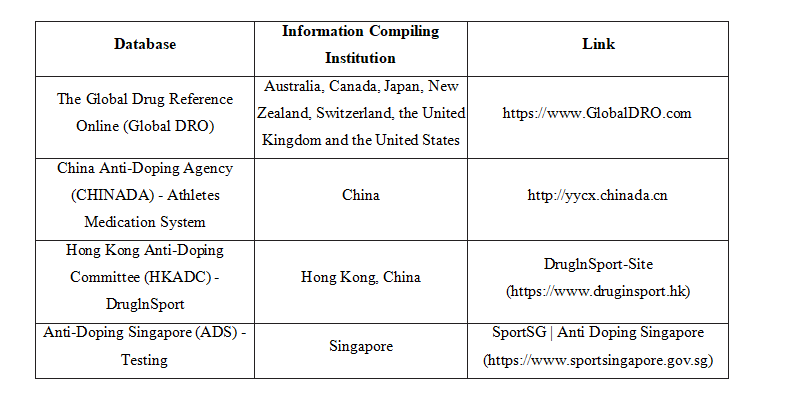
Each athlete must determine whether a substance and/or method he/she is using or considering to use is prohibited according to the 2026 WADA Prohibited List. At any time, it is strongly suggested that athletes check the status of all medications they use through appropriate means, such as consulting with their team physicians and medical support personnel. Athletes and athlete support personnel can also search relevant databases for the status of medication composition (the following databases are limited to medicines registered for use in that country):
6.Supplement Use
Unless there are any exceptional circumstances, SABGOC strongly suggests athletes not use dietary supplements. Since the production and labelling of supplements could be under poor or no supervision in many countries/regions, prohibited substances listed on the 2026 WADA Prohibited List could be included. Please note that using supplements may result in an adverse analytical finding. Therefore, athletes are advised to use supplements with extreme caution.
Before taking supplements, athletes and their support personnel should refer to or consult:
•the 2026 WADA Prohibited List;
•With their respective National Anti-Doping Organisation (hereinafter referred to as "NADO");
•With their respective IF;
•Physician.
7.Therapeutic Use Exemption (TUE)
•What is a TUE?
There are situations in which athletes need to take a prohibited substance or use a prohibited method, as specified by the WADA Prohibited List, for health reasons.
The OCA anti-doping rules stipulate a specific process for athletes to apply for and be authorised to follow the prescribed treatment.
The application for a TUE shall be approved by the ITA Therapeutic Use Exemption Committee (TUEC) upon delegation by the OCA.
•Who can apply for a TUE?
Athletes participating in Sanya 2026 must abide by the OCA Anti-Doping Rules and obtain a TUE before taking prohibited substances or using prohibited methods.
•How to apply?
Please read the information included in the links below carefully in order to assess whether you need a TUE, how you can submit it and what you need to know with regards to the anti-doping program in Sanya 2026.
The most updated information related to TUEs for Sanya 2026 can be found on the OCA website – Section 9 here and here.
8.Whereabouts and Rooming Information
Requirements for Declaring Whereabouts Information:
To protect clean athletes and enhance the efficiency and effectiveness of the fight against doping, the following requirements are established:
(1)Athletes included in the NADO and/or IF's national and international Registered Testing Pool and Testing Pool should continue to provide the required accurate whereabouts information via ADAMS. Each NOC must clearly remind its athletes of their obligation to submit accurate and complete whereabouts information in ADAMS prior to and during Sanya 2026;
(2)Each NOC should provide the rooming information for all athletes belonging to its delegation during Sanya 2026 to SABGOC via a QR code. Failure to do so will be judged as a failure to declare whereabouts information in accordance with the Rules and will result in consequences;
(3)The Chef de Mission (or another authorised NOC representative) should provide these details to SABGOC within 24 hours of the athlete's arrival at the Athletes Village, Official Hotel, or individual accommodation site;
(4)The period for providing accommodation information must meet the following two requirements:
-During Sanya 2026 (from 18 April 2026 to 30 April 2026)
-The presence of each athlete within China
(5)Each NOC should also supervise and manage the update of whereabouts information and provide further reasonable assistance upon request by SABGOC to locate the athletes within its delegation;
(6)Submitting whereabouts information is the obligation of all NOCs. Failure to provide whereabouts information may result in punishments for both the athletes and the NOCs.
Instructions for submitting whereabouts information:
(1)The OCA informs all participating NOC delegations that participating athletes must declare whereabouts information to SABGOC. Before 18 February 2026, each NOC delegation should designate a contact person and an e-mail address and send the name and e-mail of the anti-doping contact person to dop@sanya2026.cn;
(2)SABGOC will send a whereabouts information form, a QR code for whereabouts information questionnaire, a questionnaire weblink and a login password for filling out the questionnaire to each participating NOC delegation through dop@sanya2026.cn;
(3)The NOC delegation contact person needs to collect and fill in the relevant information for each athlete in the whereabouts information form, as well as the daily whereabouts information from arrival to departure. All information must be submitted in English;
(4)After completing the whereabouts information form, the NOC delegation contact person should scan the whereabouts information QR code or click the questionnaire weblink to enter the questionnaire page;
(5)The NOC delegation contact person should enter the delegation's name (in English abbreviation) and the designated login password to complete the questionnaire;
(6)Fill out the questionnaire according to the prompts and submit the whereabouts information form;
(7)Please complete the first submission within 24 hours after the athlete's arrival at the Athletes Village . If the athlete's whereabouts information changes after the first submission, please update the athlete's whereabouts information by uploading the questionnaire before the change occurs;
(8)All submissions of whereabouts information for this event (including the first submission and information updates) must be completed by uploading the questionnaire. The person responsible for filling in the form shall follow the guidelines to complete the upload, and ensure that the information contained in the uploaded file is complete and accurate
(9)The QR code and weblink to the questionnaire are as follows:

https://chinada.wjx.cn/vm/htjOC7H.aspx
Note:
If the whereabouts and rooming information questionnaire cannot be filled in through the QR code or weblink due to Internet connection problems, please send the whereabouts and rooming information form to dop@sanya2026.cn.
9.Anti-doping Intelligence
The OCA, the ITA and SABGOC are committed to protecting clean athletes and their support personnel, and upholding the integrity of sport.
"REVEAL" serves as the ITA's doping reporting platform, designed to provide all athletes, athlete support personnel, NOC staff and other relevant individuals with the opportunity to report any suspicious doping violations. REVEAL supports reporting in complete confidentiality.
REVEAL can be accessed through the following link: https://www.reveal.sport/frontpage.
If any organisation intends to promote the use of REVEAL on its website, please feel free to contact the ITA via reveal@ita.sport.
10.Pre-Games Education and Athlete Outreach Programme
The Pre-Games Education and Athlete Outreach Programme of Sanya 2026 aims to promote clean sport in a global major sporting event. The Programme provides a great opportunity for all participating athletes and support personnel to have a good understanding of anti-doping as the International Standard for Education (ISE) advocates that the first experience for an athlete in anti-doping is education.
With the Education Outreach Programme being treated as an integral part of its efforts in following up with the 2021 World Anti-Doping Code and the International Standard for Education (ISE), the OCA requires that every athlete participating in Sanya 2026 must complete the following tasks:
•ADEL International Level Athlete E-learning module (available in multiple languages). The OCA strongly suggests athletes contact their respective NADO in this regard.
OR
•An equivalent programme provided by the athlete's NADO with the required content and education which have been reviewed and approved by the OCA as a mutually recognised programme.
•Please note that athletes are required to upload the certification of having successfully completed the education in the entry form and if not, entry will be unsuccessful. During Sanya 2026, anti-doping athlete outreach activities will be held at the Athletes Village. The OCA encourages athletes and their support personnel to participate in the above-mentioned programme and activities.
For Coaches
•All coaches are required to complete the ADEL High Performance Coaches (HPC) online course.
Important:
•Both athletes and coaches should upload a proof of successful course completion (certificates) during accreditation. Failure to provide the certificate will result in an unsuccessful accreditation.
11.Services and Requirements during the Doping Control Process
11.1 Interpreters during the Doping Control Process
Sanya 2026 will recruit Doping Control Officers (DCOs) with high language proficiency from China and other Asian countries (regions). Athletes can also choose to bring their own interpreters. Only one (1) interpreter is allowed to accompany each athlete in the Doping Control Station (DCS). The interpreter may participate in the entire testing process except for witnessing the athlete's provision of urine sample.
11.2 Food and Beverage Provided to Athletes Undergoing Doping Control
Sealed water and various non-alcoholic beverages will be available for athletes in the DCS. Athletes can choose from water and any of the beverages that are available and should ensure that the selected water and beverages remain sealed before consumption. Athletes should also ensure that they do not leave their drinks unattended after opening.
Food will not be provided at the DCS. Athletes may bring their own food into the DCS or ask their supporting personnel to deliver food to the DCS. In such cases, athletes should be responsible for any risks associated with the food consumption and can only consume the food in the waiting room. Food consumption is prohibited in the processing room.
11.3 Transport Following Completion of Doping Control
If athletes and their representatives miss the daily shuttle service after the doping control process, SABGOC will provide them with transport services from the competition venues back to the Athletes Village (or Athletes Sub-village). If athletes reside outside the Athletes Village (or Athletes Sub-village), their NOC delegations shall be responsible for transporting them back to their residence.
11.4 Testing on the Closing Ceremony Day
Doping control will be conducted on the day of the Closing Ceremony. All athletes undergoing doping control must complete the testing at the competition venues before attending the Closing Ceremony. After completing doping control, SABGOC will provide transport services for athletes to the Closing Ceremony venue or the Athletes Village (or Athletes Sub-village) based on the athletes' needs. Therefore, SABGOC recommends that all athletes competing on the day of the Closing Ceremony bring with them to the competition venues the necessary items that may be required during the Closing Ceremony (such as their uniforms) as they may not have the possibility to go back to the Athletes Village (or Athletes Sub-village) before the Closing Ceremony.
11.5 Testing for World and/or Asian Records
The ITA will conduct doping control to ratify World and/or Asian Records. Athletes breaking World and/or Asian Records will be notified of testing after their competition. If an athlete who sets a new World and/or Asian Record is not immediately notified after his/her performance, the athlete must report to the venue's DCS to inform the anti-doping staff that the athlete has broken the World and/ or Asian Record.
11.6 Testing Request for National/Regional Records
To ratify a national or regional record, the NOC may request testing. The cost of such testing shall be borne by the requesting party.
The procedure for making testing requests and payments is shown as below:
(1)Inform the DCS staff at the venue of the request for testing due to breaking a national/ regional record;
(2)Apply for the testing application form after breaking a national/regional record at the DCS at the venue;
(3)The athlete/NOC completes the testing application form after breaking a national/ regional record;
(4)The athlete/NOC submits the testing application form to the Doping Control staff. The Doping Control Station Manager (DCSM) or another authorised staff member signs the testing application form. The DCSM provides the athlete/NOC with the bank account details of CHINADA for payment and confirms the amount of the payment required for the test;
(5)The athlete/NOC makes payment to CHINADA by transfer and submits the payment receipt to the relevant personnel at the DCS.
(6)The athlete undergoes doping control.
12.Doping Control Technical Procedures
12.1 Introduction
Doping control will be undertaken by the following authorities:
12.2 Equipment
Sanya 2026 will use Berlinger sample collection equipment which complies with Article 6.3.4 of the 2023 ISTI.
According to Chinese regulations on medical devices, materials used for collecting blood samples, such as needles and vacuum blood collection tubes, are all procured within China.
12.3 Personnel Authorised to Enter the DCS
The following personnel are authorised to enter the DCS during working hours upon presentation of DCS Passes:
•Athletes undergoing testing;
•One authorised athlete representative;
•Doping control staff on duty (Doping Control Station Managers (DCSMs), Chaperone Coordinators, Doping Control Station Deputy Managers, DCOs, Blood Collection Officers (BCOs), Chaperones);
•Interpreters, language service volunteers;
•IF/Asian Sports Federation (hereinafter referred to as "AF") Anti-Doping Official (designated IF/AF official in the Sport-specific Protocol);
•OCA/ITA anti-doping staff;
•Sanya 2026 Anti-Doping Operations Centre staff.
12.4 Mobile Phone and Camera Rules in the DCS
Athletes and their support personnel may use mobile phones if they do not disturb other athletes and their support personnel in the waiting room. Mobile phones may only be used in the processing room with the DCO's explicit permission.
After entering the DCS, athletes and their support personnel are prohibited to take photos and/or record the testing process with mobile phones. The use of video or audio recording devices is not allowed within the DCS.
12.5 Notification Process
The notification process must occur without prior notice. Except for the exceptions specified in the International Standard for Testing and Investigations, the athlete should be the first person informed of the need to provide a sample. The notification process will be conducted without prior notice, and all stages will be managed through the paperless terminal of the Anti-Doping Intelligent Management System (hereinafter referred to as "AIMS").
AIMS is the official doping control system of Sanya 2026. This system, developed by CHINADA, aims to improve the efficiency of the doping control process and provide a better testing experience for athletes. During Sanya 2026, AIMS will provide paperless services throughout the doping control process. After the testing is completed, athletes will automatically receive the doping control form via e-mail.
The Games-time accreditation card will be treated as the photo identification for the athletes.
Summary of Notification Process
•The Chaperone/DCO approaches an athlete, presents his/her accreditation card to show his/her identity, informs the athlete that he/she has been selected for doping control testing and specifies the type of sample that will be required from the athlete.
•The athlete must provide his/her accreditation card to confirm his/her identity. The Chaperone/DCO should hold the athlete's accreditation card and provide him/her with a DCS pass.
•The Chaperone/DCO informs the athlete of his/her rights and responsibilities.
•The athlete signs the notification form.
•If the athlete representative is not present during the notification and cannot obtain a DCS pass, the representative should explain his/her identity to the DCS entry/exit administrator. The DCO will confirm that the athlete has no other representative present and then provide the representative with a DCS pass for accompanying the athlete during the sample collection process.
12.6 Athletes' Rights and Responsibilities
Athletes and their representatives should ensure they are familiar with their rights and responsibilities during the sample collection process prior to the event.
In most countries, NADOs provide the relevant information in the local language. NOCs and IFs/AFs should contact the respective NADOs to ensure the necessary anti-doping education is provided to the Athletes.
•Rights
1)To have an accompanying representative or interpreter.
2)To ask for additional information about the sample collection process.
3)To request a delay in reporting to the DCS for valid reasons.
4)To request modifications of sample collection process (for athletes who are minors).
•Responsibilities
1)To remain under the direct observation of the DCO/Chaperone from the first contact with the DCO/Chaperone to the completion of sample collection.
2)To provide valid identification (the accreditation card for Sanya 2026).
3)To comply with the sample collection procedures.
4)To report to the DCS immediately unless there are valid reasons for a delay.
Failure to comply with the athlete's responsibilities may result in an ADRV.
•Requirements
1)Before providing a sample, athletes may eat or drink at their own risk.
2)Athletes should avoid overhydration so as to reduce the possibility of producing a diluted sample.
3)Athletes should provide the first urine sample after being notified.
12.7 In the Waiting Room
The DCS provides sealed beverages for athletes to get hydrated. However, overhydration should be avoided to reduce the possibility of producing a diluted sample. If a diluted sample is produced, sampling will take a longer time to complete. It should be ensured that the beverage is properly sealed before drinking.
12.8 Sample Collection
Information relating to sample collection process will be recorded digitally with a paperless system. Sample collection may include urine sample collection and/or blood sample collection.
Summary of Urine Sample Collection Process
•The provision of the sample should be done in a private and secure area, and the DCO of the same gender as the athlete must be present to observe the passing of urine.
•The athlete representative is advised to accompany the athlete in the entire sample collection process except for observing the passing of urine, unless the athlete is a minor or the athlete makes other requests.
•The DCO should inform the athlete of sample type and urine volume needed.
•Urine and blood are collected in no particular order.
•If the athlete is ready to provide a urine sample when waiting for blood sample collection, the urine sample can be collected first.
•The athlete should always have a selection of equipment to choose from and ensure that the equipment is secure and properly sealed.
•Containers for collecting urine samples:
•Sample collection vessel; Sample bottle;
•Partial sample sealing system.
•The athlete must provide at least 90 ml of urine with a specific gravity of 1.005, or at least 150 ml with a specific gravity of 1.003, for the sample to be accepted.
•When the athlete is ready to urinate, the DCO will accompany the athlete to the restroom.
•Before providing the sample, the athlete must wash his/her hands (without soap) or wear gloves throughout the sample provision process.
•During observed passing of urine, the DCO must ensure that the sample goes directly from the athlete's body into the sample collection vessel. Therefore, the DCO will ask the athlete to pull down or up their clothing to ensure an unobstructed view.
•It should be ensured that the athlete has the right to control the sample from the time it is provided till it is sealed in the sample equipment.
•The athlete should ensure that the sample bottle, bottle cap, bar code and sample box have matching codes.
•The DCO will instruct the athlete to seal the sample bottle. The athlete will handle the sample and seal it. The athlete should follow the DCO's instructions and ask for help promptly if anything is unclear.
•The athlete and his/her representative (if present) should ensure that all information on the doping control form is accurate.
•The athlete can choose to discard or witness the discarding of any residual urine not used for testing.
Insufficient Volume of Urine
•When the volume of the provided urine sample is less than needed, the partial sample process (temporary sealing process) will be implemented.
•Under such circumstances, testing is not completed until the athlete has provided enough volume of urine.
•The partial sample process requires the athlete to seal the sample in the sample bottle after collecting enough volume of urine.
•During Sanya 2026, the partial sample sealing system produced by Berlinger will be used.
•When waiting to provide an additional sample to ensure the collection of the required volume of urine, the athlete should be under constant observation within the DCS.
•The partial sample will be stored and controlled by the DCO in the DCS.
•The athlete ready to provide the additional urine sample should inform the DCS staff.
•The sample collection process will be repeated until enough volume of urine is acquired after combining the sample and previous partial sample.
Urine Samples not Compliant with Requirement for Suitable Specific Gravity for Analysis
•Requirement for suitable specific gravity: A sample volume of no less than 90ml to no more。 than 150ml must have a specific gravity of 1.005 or higher. A sample volume of 150ml or more must have a specific gravity of 1.003 or higher.
•If the sample provided does not meet the requirement for suitable specific gravity, the athlete will be asked to provide additional samples to meet the required specific gravity or until the TA takes appropriate further action.
•While waiting to provide additional urine samples, the athlete must remain in the sight of the DCO/Chaperone at all times.
•The athlete should be informed that he/she is not allowed to drink water before providing additional urine samples. Failure to comply may be considered a violation of the rules and be subject to investigation.
•The collection and sealing procedures for additional samples are the same as those for the initial sample.
•Whenever possible, the same DCO should oversee the collection of additional samples.
•The quantity of additional samples required is determined by the authorised TA.
General Rules for Blood Sample Collection
•The blood sample collection must be conducted in a clean and safe environment.
•Blood samples must be collected by qualified personnel.
•Urine and/or blood sample is collected in no particular order.
•When a blood sample is required for an Athlete Biological Passport (ABP), it is crucial to ensure that the athlete avoids intense exercise within two (2) hours prior to blood collection. That signifies that blood collection should not be conducted within two (2) hours following a training session or competition. For growth hormone testing, it is crucial to ensure that the athlete avoids intense exercise within 60 minutes prior to blood collection. That signifies that blood collection should not be performed within 60 minutes following a training session or competition.
•When the athlete is ready, the BCO should instruct the athlete to maintain a seated position with both feet on the ground for 10 minutes.
•The athlete should have the option to select the blood collection equipment, and the equipment shall be ensured to be safe and sealed.
•The volume of blood required depends on the type of test specified by the TA.
•The BCO is allowed a maximum of three (3) attempts to collect blood from the athlete's arm. If the required volume of blood is not obtained after three (3) attempts, the blood collection procedure should be terminated by the BCO.
Modifications for Minor Athletes
(1)General Provisions
•Athletes under 18 years old are minor athletes.
•According to Annex B Modifications for Athletes Who Are Minors of the International Standard for Testing and Investigations, testing on minors can be modified.
•Notification and sample collection process for minor athletes should follow the standard notification and sample collection process, except for the fact that modifications are necessary to be made because of their identity as minors.
•The SCA and the DCO have the right to make necessary modifications based on practical needs, provided that these adjustments do not compromise the integrity, identification and security of the sample collection process. All modifications must be documented.
(2)Notification
•Minor athletes should be notified in the presence of an adult athlete representative.
•It is suggested that minor athletes be accompanied by athlete representatives. Sample collection personnel should make reasonable efforts to encourage the minor athlete to have an athlete representative present throughout the entire sample collection process and assist the athlete in finding a representative. In special cases, if the athlete cannot find a representative, two sample collection officers will accompany the athlete until a representative is found or arrives at the DCS.
(3)Sample Collection-Urine Sample Collection
•Minor athletes should have athlete representatives present during urine sample collection.
•If a minor athlete refuses to have a representative present during sample collection, this does not invalidate the testing, but the DCO should accurately record this situation. Any further actions taken by the DCO and/or Chaperone to encourage and assist the athlete in finding a representative should also be recorded.
•If the athlete representative is present, the representative should observe the DCO/ Chaperone during the athlete's urination process, unless the athlete requests the representative to directly supervise the urine sample provision process. When only sample collection personnel are available, the second sample collection officer should observe the DCO/Chaperone instead of the urination process.
(4)Declaration of Medication and Supplements
•Athletes are strongly advised to declare any prescription or non-prescription medications and/or supplements they have taken in the past seven (7) days.
(5)Consent for Research
•Athletes may choose to accept or decline the use of samples collected during testing for anti-doping research. Whether the athlete consents to the research does not affect the sample testing results.
12.9 Ownership of Samples
Samples collected during Sanya 2026 are owned by the OCA. The OCA may transfer ownership of the samples to other RMAs or anti-doping organisations upon request.
12.10 Potential Violations
An athlete may be regarded as failure to or refusal to abide by relevant rules, resulting in a possibility of ADRV in the following situations, which include but are not limited to:
•Refusal to comply with notification procedures during the notification process, such as delaying reporting to the DCS without permission;
•Refusal to sign the testing documents after being notified;
•Failure to complete the sample collection process, for example, providing a partial sample and then failing to complete the collection, or refusing to provide additional urine samples as requested by the DCO;
•Refusal to provide blood samples due to religious reasons or fear of needles;
•Failure to complete the sample collection process or undergo testing due to injury;
•Passing of urine outside the DCS, such as during shower;
•Refusal to be tested;
•The athlete or his/her representative attempts to tamper with or destroy the sample. This includes (but is not limited to):
•The athlete attempts to add foreign objects to the collection container; The athlete representative tampers with the sample collection equipment;
•The athlete or his/her representative attempts to destroy or spill the sample.
Note: In such cases, the DCO will request the athlete to provide an additional sample and seal the compromised sample. All samples will be sent to the laboratory.
12.11 Sample Collection Personnel
SABGOC should guarantee that:
•Sample collection personnel are not minors;
•BCOs must possess the necessary qualifications and practical skills required for blood collection in China;
•The DCSMs, the DCOs and Chaperones have no conflict of interest with sample collection and all other related operations upon appointment;
•Sample collection personnel must receive adequate training before commencing their duties.
•Only sample collection personnel who have been accredited by CHINADA or other signatory Anti-Doping Organisations are authorised to conduct sample collection on behalf of SABGOC. The certification is valid only during Sanya 2026.
 Appendix 1: Sanya 2026 Anti-doping Programme Organisation Structure
Appendix 3: Contact Information
2026-01-28 22:16:03
2026-01-22 22:56:24
2026-01-22 22:50:22
2026-01-16 10:27:14
2026-01-16 10:23:30
2026-01-12 19:43:26

Official Weibo

Official Wechat

Official Tik Tok

Official WeChat Channel Account

Official rednote Account